
Software Engineers
Moving from building features to owning AI delivery with customers.
Forward Deployed Engineering Practitioner Program
Become the engineer who takes AI from a promising prototype to a working system inside a real organisation.
Online learning + optional campus immersions. Final timetable to be confirmed.
See the scheduleMap the customer workflow, constraints and success measures before choosing the technology.
Build services, data flows, AI workflows and enterprise integrations in one engagement.
Release safely, operate reliably and connect user adoption to measurable business value.
Bring your engineering foundation. Build towards delivery ownership — from understanding a customer’s problem to deploying and handing over a working AI solution.
Moving from building features to owning AI delivery with customers.
Who can build models, pipelines and prototypes, and want them running in production.
Hands-on technologists stepping into customer-facing AI delivery.
Taking AI pilots to production together. [Team terms]
Write, read and debug app code; packages, exceptions, structured data.
HTTP, REST and JSON; FastAPI and Pydantic.
SQL, tables, keys and basic transactions in Postgres.
Git, Linux terminal, dependencies, existing repos.
Basic pytest; running a containerised app.
Every lab adds to one engagement repository, from customer discovery to operational handover.
Customer brief, workflow map, requirements, risks and an outcome hypothesis.
Reproducible repository, typed service, versioned API, data layer, tests and CI.
Integrations, event processing, model routing, retrieval and agent workflows with human control.
Role-aware operator interface, deployment architecture, enterprise identity and network fit.
Tracing, service-level objectives, evaluation harness, threat model and failure exercises.
Staged rollout, adoption and value measurement, handover, executive readout and postmortem.
The capstone connects the customer workflow, architecture, integrations, failure modes, evaluation, operations, adoption and business outcomes. A chat interface alone does not meet the engagement standard.
Each module adds evidence to the same engagement repository. The curriculum is a draft; the session-to-date mapping is being finalised.
52 PLANNED SESSIONS · GUIDED LABS + CAPSTONE
Customer interviews, workflow mapping, opportunity selection, baselines, measurable acceptance and engagement scope.
Architecture and trust boundaries, codebase navigation, API contracts, transactional persistence, tests and continuous integration.
Source profiling, canonical schemas, entity resolution, reconciliation, data quality and source-to-record lineage.
Customer-system adapters, retries, idempotency, Kafka events, replay and incremental synchronization.
Model interfaces, prompt and context design, structured outputs, schema validation and controlled tool execution.
Document ingestion, hybrid search, reranking, evidence-grounded answers, access filters and knowledge freshness.
Workflow state, LangGraph orchestration, checkpoints, memory, human approvals, operator experience and MCP integration.
Evaluation datasets, failure analysis, judge calibration, model comparisons, cost and latency trade-offs, regression gates and release selection.
Enterprise identity, authorization, identity propagation, AI threat testing, privacy controls and governance evidence.
Customer deployment topologies, containers, configuration, secrets, networking, infrastructure automation and release delivery.
End-to-end telemetry, service-level objectives, actionable alerts, capacity testing, failure diagnosis and incident recovery.
User acceptance testing, pilot design, migration readiness, go-live decisions, cutover, rollback and adoption feedback.
Operational handover, measured business value, technical and executive defence, reusable assets and field-to-product feedback.
Each module adds evidence to the same engagement repository. Build one customer AI engagement from problem discovery to tested deployment, user acceptance and handover.
Customer interviews, workflow mapping, opportunity selection, baselines, measurable acceptance and engagement scope.
Architecture and trust boundaries, codebase navigation, API contracts, transactional persistence, tests and continuous integration.
Source profiling, canonical schemas, entity resolution, reconciliation, data quality and source-to-record lineage.
Customer-system adapters, retries, idempotency, Kafka events, replay and incremental synchronization.
Model interfaces, prompt and context design, structured outputs, schema validation and controlled tool execution.
Document ingestion, hybrid search, reranking, evidence-grounded answers, access filters and knowledge freshness.
Workflow state, LangGraph orchestration, checkpoints, memory, human approvals, operator experience and MCP integration.
Evaluation datasets, failure analysis, judge calibration, model comparisons, cost and latency trade-offs, regression gates and release selection.
Enterprise identity, authorization, identity propagation, AI threat testing, privacy controls and governance evidence.
Customer deployment topologies, containers, configuration, secrets, networking, infrastructure automation and release delivery.
End-to-end telemetry, service-level objectives, actionable alerts, capacity testing, failure diagnosis and incident recovery.
User acceptance testing, pilot design, migration readiness, go-live decisions, cutover, rollback and adoption feedback.
Operational handover, measured business value, technical and executive defence, reusable assets and field-to-product feedback.
The curriculum and schedule are subject to enhancements. A few modules, topics or their sequence may change as the programme is enriched, while retaining the core learning objectives.
12 dated weekends are listed in the tentative calendar. The 52 curriculum sessions will be mapped to dates in the final timetable. No session is listed for 2 January. View the tentative calendar ↗
Questions, conversations and the
quiet satisfaction of making something work.
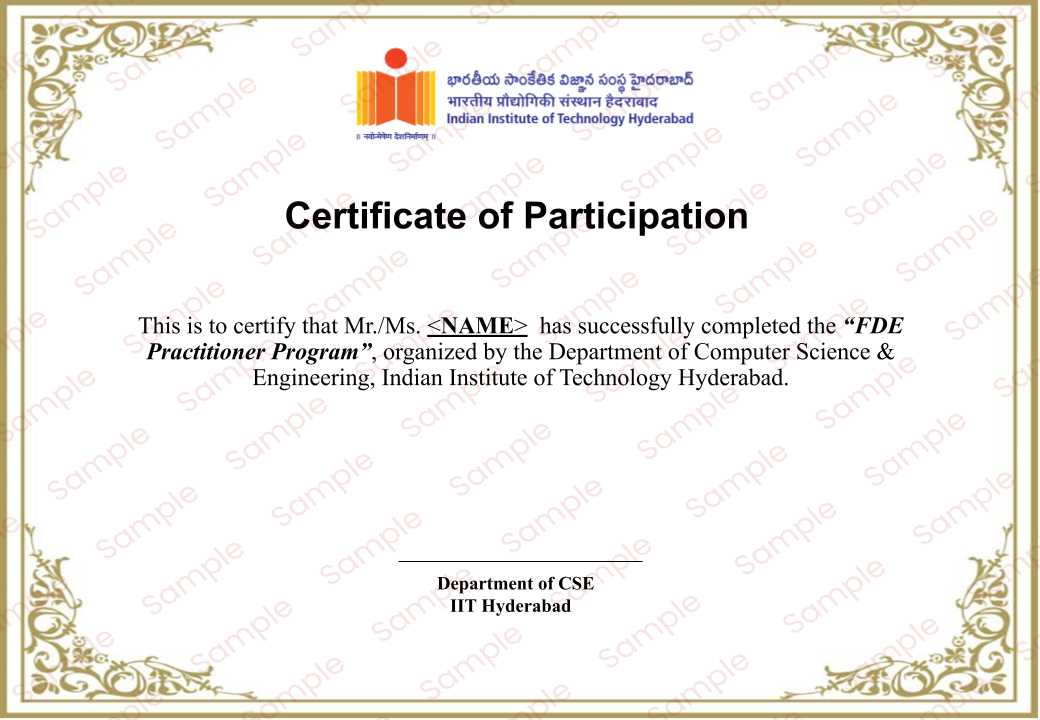
Certificate details and completion requirements will be announced with the final program release.
The final certificate title, issuer details and assessment criteria are to be confirmed.
The FDE registration form has not been provided yet. Contact the program team about the first program.
For AI engineers and software engineers with roughly 2–5 years of experience, moving into customer-facing AI delivery.
Working programming skills, API familiarity and readiness to build and review software. This is a practitioner program, not a first course in coding.
Early-bird price applies to the first 20 registrations.
Runs from 5 December 2026 – 27 February 2027.
Works with customers to understand a business problem and deliver a working solution, combining AI and software engineering with discovery, integration, deployment and stakeholder communication.
No prior GenAI or ML experience is needed, only solid software engineering foundations (see Eligibility). You will learn LLMs, retrieval, agents and evaluation hands-on, using a Python-first, open-source stack that includes FastAPI, Postgres, LangGraph, Qdrant, Ragas, authentik, Docker, OpenTelemetry and OpenObserve.
Yes, if your role is hands-on and you meet the prerequisites. Identity, secure integrations, data pipelines, deployment and observability are core to the curriculum.
A team capstone: an enterprise AI workflow with evidence retrieval, human approval and an audit trail, taken from discovery through deployment and handover.
No. The required labs use programme-provided scripts and free tiers. Optional experimentation outside this may cost extra.
Through working software, tests, evaluation results, architecture and security evidence, and a capstone presentation where you defend your decisions. Certificate requirements will be announced separately.
Yes, the programme is designed for working professionals. It runs for 13 weeks, with 52 sessions and 156 live hours. Each session includes a 90-minute lecture and a 90-minute lab. Plan for about 12 live hours a week, plus independent time for assignments and the capstone.